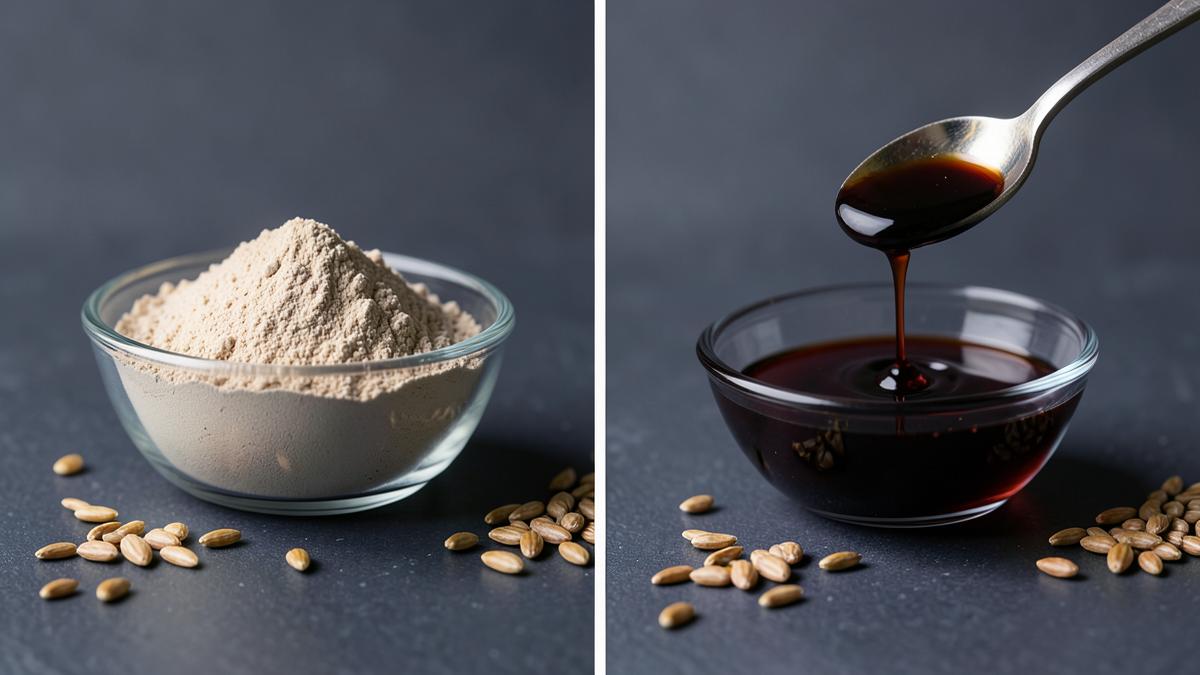
Malt extract is made from malted barley, so it contains gluten and is not suitable for people with coeliac disease: it must be declared as an allergen on the label. It supplies maltose, roasted aroma and color, and is used in bakery, biscuits, cereals and malted beverages, either as powder or as syrup.
What malt extract is
Barley is steeped and allowed to germinate (malting), which activates enzymes that break starch down into sugars. The grain is kilned, mashed in hot water, and the resulting sweet liquid is concentrated. Stop there and you get malt syrup or liquid malt extract; spray-dry it and you get malt extract powder.
It is also sold as malted barley extract, malt powder or barley malt extract. Two main families exist:
- Diastatic: retains enzyme activity (diastatic power) and supports dough fermentation.
- Non-diastatic: enzymes are heat-inactivated; used for color, aroma and sugars.
Gluten and labeling
Barley is one of the gluten-containing cereals, along with wheat, rye and their hybrids. Because the extract is produced from malted barley and is not put through a gluten-removal process, the finished ingredient contains gluten and must be declared as such.
Practical points for labeling and quality control:
- The international reference for a "gluten-free" claim is below 20 mg/kg (20 ppm), the Codex Alimentarius threshold adopted by most regulatory frameworks. Barley malt extract is far above it.
- The ingredient list must name the source cereal, for example "malt extract (barley)", with the allergen emphasized in the format required by the destination market.
- "Malt flavor" is not the same as "gluten free": if it comes from barley, it is still a declarable allergen.
- Malts from other cereals (corn, rice, sorghum) do allow gluten-free formulation, but they are different products with a different flavor profile and cost.
This is technical and labeling information, not medical or nutritional advice.
Composition and functional properties
| Component / property | Role in the formulation |
|---|---|
| Maltose and dextrins | Fermentable sugars, body, moderate sweetness |
| Amino acids and soluble proteins | Maillard reaction: color and roasted aroma |
| Minerals | Yeast nutrition |
| Diastatic power (degrees Lintner) | Enzyme activity on starch (diastatic grade only) |
| Color (EBC / Lovibond) | Crumb and crust tone |
| Hygroscopicity | High: keep sealed, dry environment |
What malt extract is used for
- Bakery: feeds the yeast, improves volume and gives a deeper golden crust.
- Biscuits and cakes: even color, roasted flavor and better texture.
- Cereals, granola and bars: natural binder that also adds flavor.
- Malted and chocolate beverages: flavor base for instant powders.
- Craft brewing: fermentable sugar source in extract recipes.
- Confectionery: caramel and malt notes in fillings and coatings.
Powder vs. syrup: which to choose
| Criterion | Malt extract powder | Malt syrup / liquid extract |
|---|---|---|
| Dosing | Easy to weigh and dry-blend | Needs pump or weight dosing, sticky |
| Handling | Hygroscopic: keep sealed | Viscous, easier when slightly warmed |
| Shelf life | Longer when kept dry | Shorter; temperature sensitive |
| Solids | ~95-97% | ~75-80% (rest is water) |
| Logistics cost | Less weight per kg of solids | You ship water |
| Typical use | Premixes, instant powders, industrial bakery | Brewing, craft bakery, syrups |
For most industrial premixes powder is more practical; syrup fits plants that already dose liquids.
Malt extract substitutes
No substitute reproduces the full profile, but depending on the goal:
- Honey or rice syrup: sugars and browning; flavor changes.
- Dextrose or glucose syrup: fermentable sugar with no malt aroma.
- Molasses: deeper color and more bitter notes.
- Corn, rice or sorghum malt: the route when a gluten-free formulation is required.
Any substitution changes sweetness, final color and oven behavior, so validate with plant trials.
Availability in Venezuela
Grupo Polo supplies malt extract powder for the food industry in Venezuela, shipped from Caracas with technical documentation per lot.
- Product data sheet: Malt Extract powder
- Full ingredient guide: malt extract powder: uses and supplier in Venezuela
- Ask for price and availability: request a quote
- See also: how to source food ingredients from Venezuela and quality certifications to require from a supplier.
Frequently asked questions
Is malt extract gluten free?
No. It is made from malted barley, a gluten-containing cereal, and the finished ingredient is far above the 20 ppm limit used for a gluten-free claim. It must be declared as an allergen.
Is barley malt extract wheat free?
It contains no wheat, but it is not gluten free: barley gluten is present, so it is unsuitable for coeliacs and for gluten-free claims.
What is malt extract used for?
It provides fermentable sugars, golden color and roasted aroma. In bakery it feeds the yeast and improves crust and volume; in beverages and cereals it works as a flavor base.
What can replace malt extract?
Honey, rice syrup, dextrose or molasses when only sugar and browning are needed, or corn, rice or sorghum malt when a gluten-free formulation is required. Flavor changes in every case.
Is malt extract the same as malted barley?
Malted barley is the grain; malt extract is the sugar concentrate obtained from that grain. The extract is the format that gets dosed into a formulation.
How much malt extract is used in bread?
As a general reference, 0.5% to 2% on flour weight, adjusted to the target color and aroma and to whether the malt is diastatic or not.
